

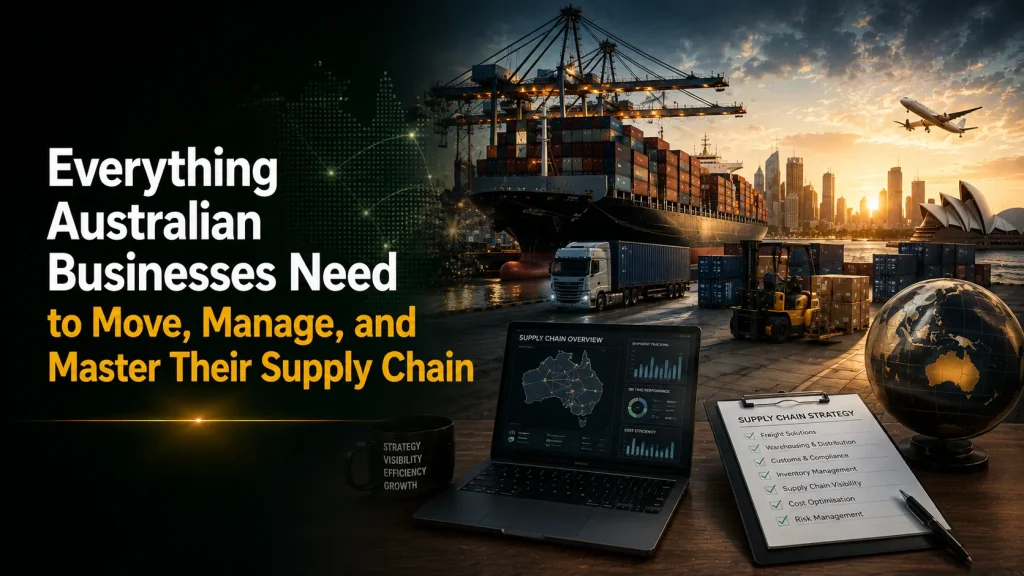
Everything Australian Businesses Need to Move Manage and Master Their Supply Chain
Written by the FR8WISE Supply Chain Team | FR8WISE is a Sydney-based logistics and supply chain consultancy delivering end-to-end FR8...
We’re here to answer any question you may have.
Would you like to join our growing team?
careers@fr8wise.com
Have a project in mind? Send a message.
info@fr8wise.com
Level 2, 88 George Street
The Rocks NSW 2000
We are here to answer any question you may have. Feel free to reach via contact form.
A manufacturing supply chain in Australia lives or dies by inbound reliability. When a single missing component stops a line, the cost is not the part but the idle labour, the delayed orders and the unhappy customer. FR8WISE helps Australian manufacturers plan imports, inventory and customs so production keeps running.
Lead-time variability is the first. Overseas suppliers quote lead times, but ocean transit, port congestion and customs checks add uncertainty. Planners who build to the quote rather than the real range tend to carry too much or too little stock.
Cost structure is the second. A low unit price can hide freight, duty, GST timing and storage costs. For manufacturers, working capital matters as much as price, so holding months of stock to cover long lead times has a real cost.
Compliance is the third. Raw materials and components need correct classification, valuation and origin documentation. Where finished goods are exported, rules of origin determine whether customers can claim preferential rates under agreements like CPTPP or AANZFTA. Duty drawback may be available on some imported inputs that are later re-exported, and it is worth checking.
Scale is the fourth. Small and mid-size manufacturers often lack a dedicated logistics team, so supply chain decisions sit with a production manager who is also doing five other things.
Our Mastery in Supply Chain & Logistics programme gives planners, buyers and managers a shared understanding of freight, customs and inventory. It suits teams without a dedicated logistics specialist.
Smart Procurement Strategies compare suppliers on landed cost, reliability and lead-time spread, and help you decide where dual sourcing or local supply earns its place.
Our Import Customs Compliance Analysis reviews classification, valuation and origin on inputs and finished goods, flagging duty-saving options and documentation gaps. Our supply chain optimisation work then looks at transport, warehousing and strategic inventory planning so that your safety stock matches your real risk.
It depends on lead-time variability, demand volatility and the cost of a stoppage. Measure the real spread of your lead times, not the quoted average, and set stock to cover the gap.
It is a scheme that may refund duty on imported goods that are later exported, subject to conditions. Check eligibility with the ABF before relying on it.
Compare total landed cost, reliability and flexibility, not just unit price. Local suppliers often cost more per unit but reduce lead time and inventory.
If you are reviewing suppliers, trimming inventory or preparing to export, a structured look at your supply chain is a good first step. Our automotive industry page covers a related sector, or speak to our Sydney team about your manufacturing supply chain.
Stay ahead with our latest insights on achieving clarity, certainty, and results-driven impact for your supply chain.


Adding {{itemName}} to cart
Added {{itemName}} to cart