

What are the biggest supply chain risks in Australia in 2026?
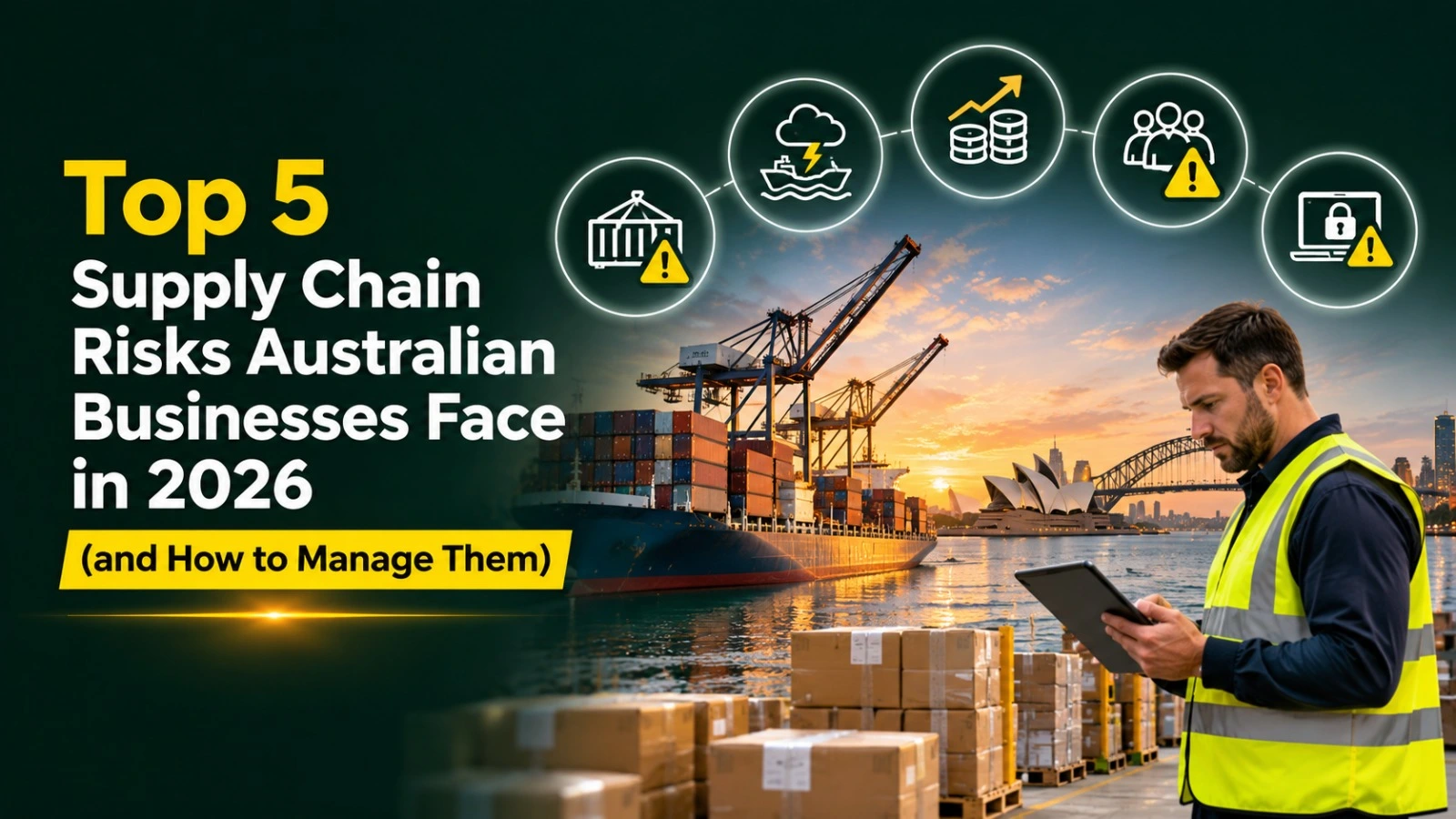
Short answer: The five biggest supply chain risks for Australian businesses in 2026 are (1) fuel and geopolitical shocks, especially disruption around the Strait of Hormuz, (2) cyber and AI-related digital risk, (3) climate and extreme weather, (4) poor visibility and reactive risk management, and (5) workforce gaps and compliance pressure. The most effective response is to map your suppliers and routes, build buffers where a failure would hurt most, and rehearse a documented crisis plan before disruption hits.
This guide is for operations, procurement, and logistics managers running a supply chain in Australia who want practical steps, not theory. It draws on 2026 research from BSI, Proxima (a Bain & Company consultancy), the Australian Logistics Council, the World Economic Forum, and others, and every claim links to its source.
Why are Australian supply chains more exposed than most?
Geography is the structural problem. Proxima’s 2026 Global Supply Chain Resilience Outlook found that only 5% of Australian firms could keep operating for four to six months through a major supply chain disruption. Proxima’s Australian lead attributes this to geographic isolation, long lead times, and reliance on long-haul routes. A separate report from the same survey reported that almost 60% of Australian businesses would fold within three weeks of a major supply shock.
There is also a counterpoint worth knowing. The Productivity Commission’s Vulnerable Supply Chains work concluded that only a small share of imports are highly vulnerable, so the goal is targeted resilience, not stockpiling everything. This guide takes that approach.
Risk 1: How do fuel and geopolitical shocks affect Australian supply chains?
Short answer: Australia imports most of its diesel, and diesel moves most of its freight, so closing a chokepoint like the Strait of Hormuz raises freight costs, tightens capacity, and can threaten supply within weeks.
What happened in 2026. Iran closed the Strait of Hormuz on 28 February 2026, blocking most crude and diesel shipments out of the Gulf. Australia shifted its buying toward South Korea, whose share of Australia’s diesel imports rose from 29% in 2025 to almost half by October 2026, yet South Korean refineries themselves source more than half their crude from the Middle East. So the diversification helped, but it did not remove the underlying exposure.
Why it matters for freight. The Australian Logistics Council warned in March that minimum stockholding obligations covered only around 32 days of diesel, against the International Energy Agency’s 90-day benchmark. By August, the council reported that Hormuz restrictions were affecting refined fuels, LNG, petrochemicals and tanker capacity, and that falling crude prices should not be read as an equal fall in diesel costs. Carriers responded quickly: DHL reportedly moved its Australian fuel surcharge review from monthly to weekly after diesel rose 30 to 50 per cent.
What it does to your business
- Weekly or even daily fuel surcharge changes that break quoted freight budgets
- Tighter carrier capacity on regional and long-haul lanes
- Higher input costs for any product that depends on petrochemicals or imported components
- Delivery delays for agriculture, construction, and retail stock
How to manage it
- Re-quote on a fuel-indexed basis. Agree a transparent fuel surcharge formula with carriers instead of a flat rate that will be renegotiated mid-contract.
- Identify fuel-critical lanes. Rank routes by how many deliveries and how much revenue depend on long-haul road freight.
- Rebalance transport modes. Shift suitable volume to rail or coastal shipping. BSI found 84% of surveyed organisations plan to change transport modes.
- Hold buffer stock on a small set of critical SKUs, not across the whole range.
- Use more than one supplier region for items that cannot be substituted, and test the second source before you need it.
Risk 2: How do cyber-attacks and AI create supply chain risk?
Short answer: Your logistics systems, suppliers’ systems and AI tools are all points of failure, and an outage at any one can halt tracking, invoicing or dispatch.
- BSI’s October 2026 study found that 40% of surveyed organisations were hit by a cyber incident in the past year, yet only 44% feel fully prepared for severe technology failures or cyber incidents.
- Two-thirds (67%) believe AI will increase the risk of theft and cybercrime in supply chains.
- The World Economic Forum figure cited by Clayton Utz is that 68% of global organisations reported an increase in digital supply chain disruptions, while only 64% have a process to assess AI tool security before deployment.
How to manage it
- Ask every logistics, warehouse, and software provider for evidence of security controls (for example, ISO/IEC 27001 certification or equivalent).
- Require multi-factor authentication for every portal that touches orders, rates, or shipment data.
- Map which suppliers hold your data and where it is stored, including offshore.
- Write a manual fallback procedure so dispatch, receiving and invoicing can run for 48 hours without your main system.
- If you are a critical infrastructure operator, check your obligations under the Security of Critical Infrastructure Act 2018, which requires responsible entities to identify and manage supply chain risk across 11 sectors.
Risk 3: How does extreme weather disrupt Australian supply chains?
Short answer: Bushfires, floods and heat close roads, damage facilities and push lead times up, and forecasters expect conditions to stay volatile into 2027.
BSI reports that 35% of Australian organisations were affected by climate-related disruption in the past year. BSI’s supply chain resilience lead said 2026 was the hottest summer on record for several countries, with El Niño patterns keeping conditions volatile into 2027, and BSI Australia warned of another hot summer with higher bushfire risk.
How to manage it
- Overlay your supplier, warehouse, and carrier locations on flood and bushfire risk maps.
- Pre-agree alternative routes for your top 10 lanes, with a named backup carrier.
- Move inventory forward before peak fire and cyclone seasons for your region.
- Consider a second warehouse in a different climate zone for critical products.
- Confirm what your business interruption insurance covers when a supplier, not your own site, is affected.
Risk 4: Why are poor visibility and reactive planning a supply chain risk?
Short answer: Many disruptions become crises because businesses cannot see where their exposure is, or cannot decide fast enough. This is often the most fixable risk on the list.
BSI’s data shows the gap clearly:
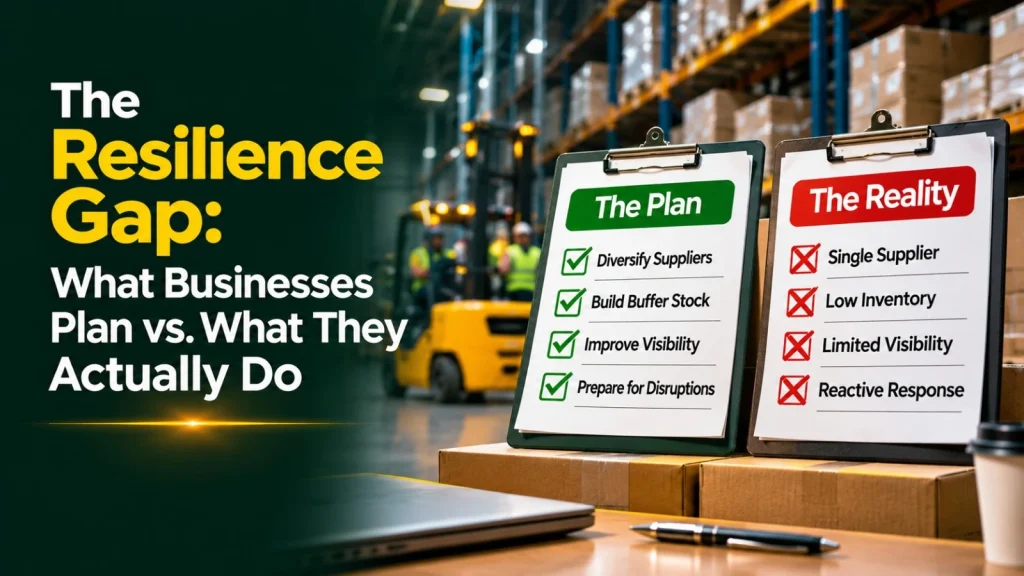
- 60% say supply chain risk is managed mainly reactively
- 49% have no formal, documented risk process
- Only 21% can act on the same day a disruption hits
- Only 34% have complete visibility of supplier locations and geographic exposure
- 27% did not follow their agreed crisis plan during the recent Iran-Israel conflict
How to manage it
- Build a supplier map that goes beyond tier 1 to the sites and ports your critical items pass through.
- Write a one-page crisis playbook: who decides, who is called, what the spending limit is, and what customers are told.
- Run a scenario exercise twice a year with procurement, finance, operations and sales in the room. BSI notes 44% plan scenario planning, but few do it consistently.
- Track a short set of early-warning indicators: carrier on-time performance, fuel surcharge changes, supplier lead-time creep and port congestion.
- Consolidate data into one view, such as a transport management system or control tower, so decisions use current numbers.
Risk 5: How do workforce gaps and compliance pressure affect logistics?
Short answer: Shortages of drivers, warehouse staff and freight handlers raise costs and make service less predictable, while compliance obligations add audit and reporting work.
- Over-reliance on casual labor and overtime increases fulfilment cost and error rates.
- Compliance duties span modern slavery reporting, APRA prudential requirements for regulated entities and critical infrastructure rules, all of which require organisations to look through to their supply chains.
- The Australian Industry Group reports that 45% of industrial businesses see supply chain regulation as a barrier to resilience investment, so compliance cost needs to be planned, not discovered.
How to manage it
- Automate repeatable admin: booking, track-and-trace updates and proof-of-delivery matching.
- Invest in onboarding and cross-training so one absence does not stop a shift.
- Choose partners who carry compliance expertise in-house rather than handing the burden back to you.
- Keep supplier audit and modern slavery evidence in one place, updated on a schedule.
Risk comparison table
| Risk | Early warning sign | Fastest first action | Typical owner |
| Fuel and geopolitical shocks | Surcharge changes, carrier capacity tightening | Move to fuel-indexed freight contracts | Logistics/procurement |
| Cyber and AI risk | Supplier outages, unusual login activity | Enforce MFA and request security evidence | IT/operations |
| Climate and weather | Seasonal outlooks, road closures | Map sites against hazard data | Operations/risk |
| Visibility and reactivity | Slow decisions, conflicting data | Build a supplier map and crisis playbook | Supply chain lead |
| Workforce and compliance | Rising overtime, audit findings | Cross-train and centralize compliance records | HR/operations |
What should I do in the next 30, 60, and 90 days?
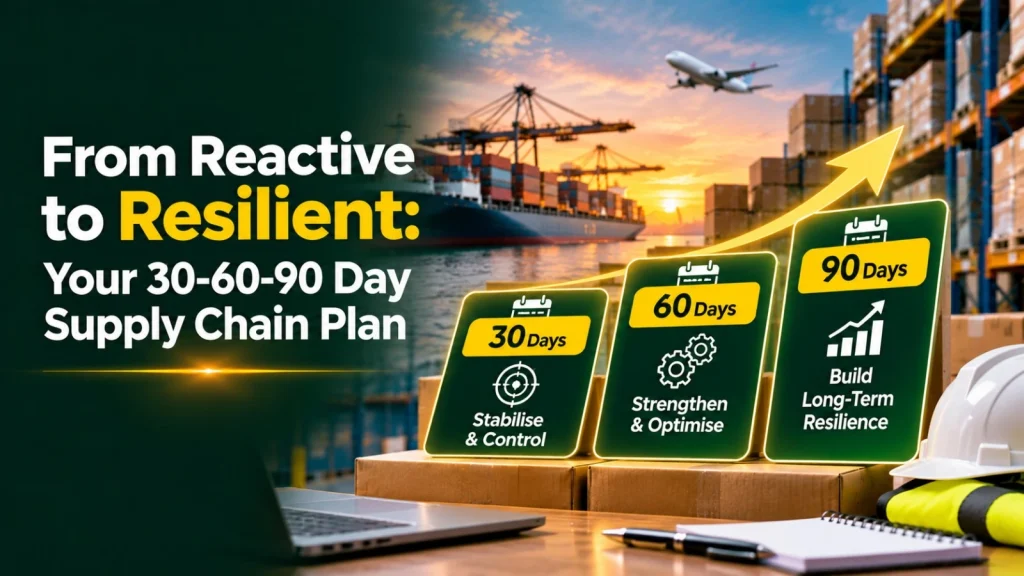
Days 1 to 30: See the risk. List your top 20 products by revenue, the suppliers and routes behind them, and the single points of failure. Review every freight contract for fuel surcharge terms.
Days 31 to 60: Reduce the biggest exposure. Qualify a backup supplier or carrier for your two most critical lanes. Raise safety stock only on the SKUs where a stockout costs more than holding stock. Roll out MFA across supplier portals.
Days 61 to 90: Prove it works. Run a scenario exercise using a fuel shock or a flood closure. Write down where decisions stalled, fix them, and schedule the next test. Build a simple risk dashboard so leaders see the same numbers.
When should you use supply chain services or supply chain consulting?
If you do not have the time or in-house skills to map suppliers, renegotiate freight contracts or design a resilient network, outside help can pay for itself quickly.
- Supply chain services suit businesses that want a partner to run or optimise freight, warehousing and visibility day to day.
- Supply chain consulting suits businesses that need an independent risk assessment, network redesign or a documented crisis plan.
- A logistics company in Australia with local carrier relationships can also give you faster access to alternative capacity when your usual lane fails.
Not sure where to start? Book a supply chain risk review with fr8wise, and we will walk you through your top exposures.
FAQs
What are the main supply chain risks in Australia in 2026?
Fuel and geopolitical shocks, cyber and AI-related digital risk, extreme weather, poor visibility with reactive planning, and workforce and compliance pressure. BSI’s October 2026 research found 40% of surveyed organisations hit by cyber incidents and 39% affected by conflict or political instability in the past year.
Why is Australia’s supply chain so vulnerable?
Australia is geographically isolated, relies on long-haul routes and imports most of its diesel. Proxima’s 2026 survey found only 5% of Australian firms could operate for four to six months through a major disruption.
How does the Strait of Hormuz affect Australian businesses?
It affects freight costs and fuel availability. Most Australian diesel is imported, and the Australian Logistics Council has said diesel underpins road freight, rail, ports, agriculture, mining and construction. Carriers have responded with more frequent fuel surcharge changes.
What is supply chain risk management?
It is the process of identifying what could interrupt the flow of goods, estimating the likelihood and cost, and putting controls in place, such as backup suppliers, buffer stock, insurance and tested crisis plans.
How can a small business improve supply chain resilience on a budget?
Start with a supplier and route map, agree fuel-indexed freight terms, secure a backup supplier for your top two products, and write a one-page crisis plan. None of these needs new software.
What is the difference between supply chain services and supply chain consulting?
Supply chain services are ongoing operational support such as freight management, warehousing and visibility. Supply chain consulting is advisory work: assessing risk, redesigning networks and building plans.
How often should I review supply chain risks?
At least quarterly, and immediately after a major event such as a port closure, a cyber-incident or a fuel price spike. BSI found only 36% of organizations hold cross-functional meetings weekly.
How do I choose a logistics company in Australia?
Check carrier coverage on your lanes, transparency on fuel surcharges, security certifications, visibility technology and references from businesses of your size. Ask how they handled the 2026 fuel disruption.