


Quick answer: The seven key warehouse processes are receiving, put-away, inventory control, picking, packing, dispatch, and returns. Each one hands off work to the next, so a mistake at the dock turns into a short-shipped order days later. Fix receiving and inventory accuracy first. Everything downstream depends on them.
What are warehouse processes, and why do seven of them matter?
Warehouse processes are the repeatable steps that move stock from a supplier’s truck into storage, out to a customer, and back again if it returns. Seven cover almost everything. Names vary between sites; the jobs don’t.
| Process | The job | How it usually fails | Metric to watch |
| Receiving | Check goods in against the order | Counting pallets, not cartons | Receiving accuracy |
| Put-away | Store goods where they can be found | Stock parked wherever there’s space | Dock-to-stock time |
| Inventory control | Keep the system and the shelf in agreement | Counting only once a year | Location accuracy |
| Picking | Collect the right items for each order | Long walks, no checking | Pick accuracy, lines per hour |
| Packing | Protect and document each order | Wrong box, missing paperwork | Damage rate |
| Dispatch | Hand orders to carriers on time | Orders ready after the truck leaves | On-time dispatch rate |
| Returns | Decide what happens to goods that come back | A pile in the corner | Returns turnaround time |
1. Receiving: how do you check goods in without creating tomorrow’s errors?
Receiving is the process of unloading an inbound delivery, checking it against the purchase order, and recording what actually arrived. It’s the only point where you can compare the supplier’s version of events with the physical truth.
The steps are short. Unload, count cartons or units (not only pallets), check the paperwork, look for damage, label, and record. If something’s wrong, write it on the docket while the driver is still there.
An advance shipping notice (ASN) helps, because the dock can scan against a list the supplier already sent. But only if somebody scans. Otherwise, it’s just a document.
My view: slow the dock by ten minutes a delivery before you accept sloppy counts. A discrepancy found at the door is a supplier claim. Found at dispatch, it’s a customer problem.
2. Put-away: where should stock go once it’s checked in?
Put-away is moving received goods to a storage location and recording that location. The test is simple: can someone who’s never seen this pallet find it in under two minutes?
Fast movers belong near packing at waist-to-shoulder height. Slow movers go higher and further away; heavy items low. This is slotting, and a marker pen and a walk through the building get you most of the way.
The trap is “temporary” locations. Stock parked at an aisle end for a day is still there a month later, and the system never knows. Scan every pallet, even at 5 pm on a Friday.
3. Inventory control: how do you keep the system and the shelf in agreement?
Inventory control is the work of making sure recorded stock matches physical stock, usually through regular cycle counts instead of one big annual stocktake. A cycle count checks a small, planned slice of locations each day.
Why bother? A system that says forty when there are ten sends a picker on a wasted walk and a customer a promise you can’t keep.
Count fast movers more often than slow ones, and recount any location where a picker reports a shortage. A variance you explain is a process fix. One you write off will happen again.
4. Picking: why does it take so much of your labour?
Picking is collecting the right items, in the right quantity, from storage to fill customer orders. It’s usually the biggest labour cost in the building, because people spend most of the shift walking.
Method matters more than speed. Discrete picking sends one person after one order. Batch picking collects several orders’ worth of one item at once. Wave and zone picking split work by time or area. Many small orders favour batching; a few large ones favour discrete.
Scanning at the point of pick is the cheapest accuracy upgrade there is. Then check a sample of orders before packing and track errors by location. It’s usually a bay problem, like two similar items side by side, not a people problem.
5. Packing: what does a packed order need before it leaves?
Packing is the process of checking, protecting, labelling, and documenting an order so it reaches the customer intact. It’s also the last point where you can catch a picking error cheaply.
A good pack station has the right box sizes, filler, a way to confirm contents against the order, and a label that matches the paperwork. Oversized boxes cost freight. Undersized ones cost returns.
Consolidate multi-zone orders so partials don’t leave separately by accident, and record who packed what. When a customer reports a problem, traceability is the difference between a fix and a guess.
6. Dispatch: how do you hit the carrier’s cut-off every time?
Dispatch is the physical release of packed orders to a carrier. In most warehouses, “dispatch” is the handover at your dock, while “shipping” covers the broader work of moving the goods and paperwork. People use the terms loosely, so agree on your own definitions.
The whole job is timing. Work backwards from the carrier’s pickup. If the truck leaves at 5:00 and loading takes twenty minutes, you must pack your last order by 4:30, so picking finishes earlier still.
Stage by carrier and route, not in one pile. Check the manifest against the pallet before the driver signs, and record the actual departure time.
7. Returns: what happens to goods that come back?
Returns processing is receiving, inspecting, and deciding what to do with goods a customer has sent back. Supply chain bodies treat it as a process in its own right. ASCM’s SCOR Digital Standard lists Return as one of its six primary processes, and handles customer returns under Deliver Return.
Most sites don’t plan for it. Returns land in a corner, and weeks later someone asks what’s in the boxes.
Give returns a fixed route: receive, scan against the original order, inspect, decide. Options are usually restock, repair, return to supplier, recycle or scrap. Record the decision and the reason, because reason codes show which products and suppliers cause problems. And update stock fast: a returned item back on the shelf but not in the system is invisible.
What about value-added work?
Kitting, relabeling and light assembly are an eighth process at sites that offer them. The risk is tracking: once components become a kit, your system must know the stock changed form. If it can’t, don’t offer the service yet.
How do the seven work together in one day?
They run as a loop, with returns feeding straight back into receiving.
- Count and record deliveries at the dock.
- Put away. Move stock to a scanned location.
- Cycle count a planned slice of the building.
- Release orders in cut-off order.
- Check, document, and label.
- Stage, manifest and release loads.
- Anything that comes back re-enters at step 1.
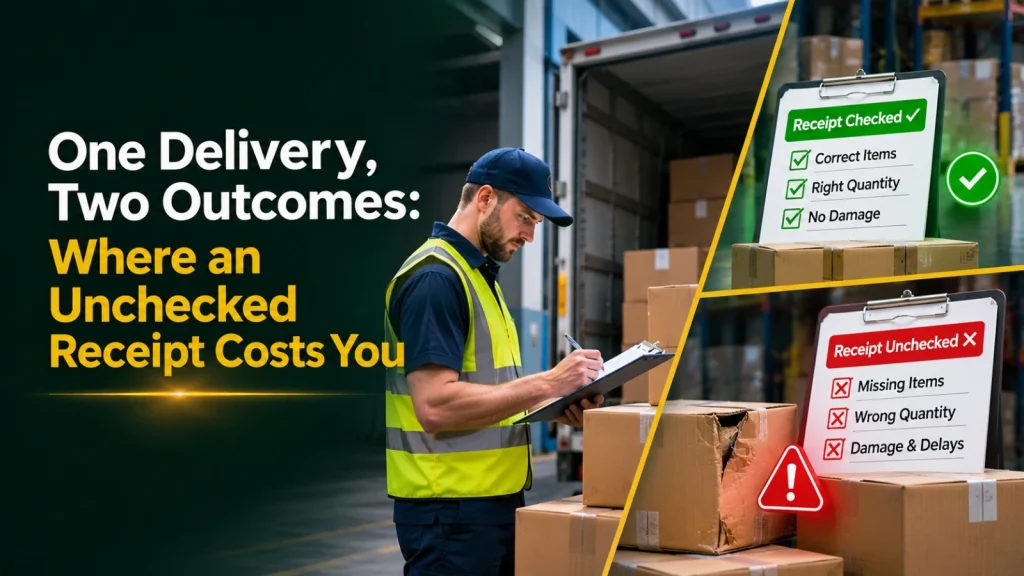
Worked example: one inbound delivery, two outcomes
Illustrative example. The numbers are invented to show the logic, not real data.
A 40-foot container arrives with 20 pallets. The purchase order says 960 cartons of one product. The supplier shipped 930. A customer order for 40 cartons of that product must leave at 5:00 pm.
| Step | Without carton counts | With carton counts |
| Receiving (9:30 am) | Pallets counted, 20 of 20. Signed clean. | Cartons scanned, 930 of 960. Shortage noted on the delivery docket. |
| Stock record | Shows 960 | Shows 930, supplier claim raised same day |
| Picking (2:15 pm) | System says 40 available, picker finds 10 | Order flagged at 9:45, customer told by 10:00 |
| Dispatch (5:00 pm) | Truck leaves 30 cartons short, supervisor hunts for 25 minutes first | Customer’s choice: partial ship or wait |
| Outcome | Angry customer, a backorder, an unrecoverable claim | A short delay and a recoverable claim |
The careful route costs ten extra minutes at the dock. The other costs a customer.
Which process should you fix first? A decision guide by warehouse type
| Warehouse type | Fix first | Why |
| Ecommerce and parcel fulfilment | Picking and packing | High order volume, small lines, error rates compound |
| B2B pallet distribution | Receiving and dispatch | Few, large movements where a miss is costly |
| Temperature-controlled or food | Receiving and inventory control | Dates, batches and rejection windows are strict |
| 3PL with multiple clients | Inventory control and returns | Each client needs separate stock records and rules |
| Spare parts and slow movers | Put-away and inventory control | Finding the one part matters more than speed |
Unsure? Start with receiving. Nothing downstream is more accurate than what came in.
What do small, mid-size and large warehouses each need?
- Small site, a handful of staff: a spreadsheet, barcode labels, a fixed location per product and a weekly count. Your people know the stock.
- Mid-size site, around twenty staff: a warehouse management system (WMS) with scanning, directed put-away and a named owner per process. Memory stops scaling here.
- Large site, a hundred or more staff: automated task assignment, slotting reviews, wave picking and written exception rules. People handle exceptions, not every move.
What does a process failure cost? A formula you can use
Weekly cost of failure = (errors × cost per error) + (rework hours × loaded hourly rate) + missed cut-off charges.
Cost per error = reship freight + product value written off + customer service time + returns handling.
Take error counts from your returns log and claim register, rework hours from timesheets, and your own rates. Run it on one bad week first. If it’s small, the fix is a checklist. If it’s large, you’ve found the budget for scanning or a WMS.
How should you prepare your warehouse for peak season?
Black Friday falls on 27 November this year, and the December rush follows. This is the week to tighten up.
- Count your fast-moving locations now, so peak starts with accurate stock.
- Agree last-pick times against carrier cut-offs in writing.
- Reserve returns space. January returns are predictable.
- Brief temporary staff on scanning rules on day one, and write the if-then rules: if inbound is late, which orders move?
What local rules should you check?
Confirm details with the official source first: your workplace safety regulator (forklifts, racking), dangerous goods rules, food safety rules for temperature and dates, and customs rules for bonded stock.
How can you tell it’s a process problem, not a space problem?
- The same SKUs go missing every month.
- Returns pile up for weeks before anyone looks.
- Orders are ready, but the truck has already left.
A bigger building fixes none of these.
What are the most common warehouse process mistakes?
- Counting pallets, not cartons. The error surfaces later, elsewhere.
- Leaving put-away unscanned. Stock exists but can’t be found.
- Annual stocktakes only. You find a year’s errors at once.
- No dispatch cut-off rules. Everyone assumes the truck will wait.
- Treating returns as an afterthought. They hold your best quality data.
- Skipping the post-mortem. A repeated error is a process nobody owns.
What belongs on a daily warehouse process checklist?
Copy this into your shift routine.
- ☐ Inbound deliveries are booked to doors, advance notices loaded
- ☐ Receiving counts cartons or units, not only pallets
- ☐ Every received pallet has a scanned location
- ☐ Today’s cycle count list is assigned
- ☐ Pick lists are released in cut-off order
- ☐ Carrier pickup times are posted at the dispatch bay
- ☐ Manifests match loaded pallets before drivers sign
- ☐ Today’s returns are scanned, inspected, and given a decision
- ☐ Yesterday’s errors are reviewed, each with an owner
What should you look for in a warehouse management system?
Test any WMS with your messiest day, not the demo data.
| Must-have | Nice-to-have |
| Barcode scanning at receipt, put-away and pick | Voice picking |
| Directed put-away and location tracking | Slotting suggestions |
| Cycle count scheduling | Dock appointment scheduling |
| Order allocation and wave or batch release | Labour planning |
| Returns handling with reason codes | Customer returns portal |
| Accuracy and cut-off reports, order-system integration | Dashboards and alerts |
Which metrics show whether your warehouse processes work?
| Metric | How to calculate | Healthy direction |
| Receiving accuracy | Lines received correctly ÷ lines received | Up |
| Dock-to-stock time | Time from truck arrival to stock available | Down |
| Location accuracy | Locations matching the system ÷ locations counted | Up |
| Pick accuracy | Lines picked correctly ÷ lines picked | Up |
| Lines picked per labour hour | Lines picked ÷ pick labour hours | Up, until accuracy slips |
| On-time dispatch rate | Orders leaving by cut-off ÷ total orders | Up |
| Returns turnaround | Days from receipt to a decision | Down |
When don’t you need a warehouse management system?
With a few dozen orders a day and a small range, a spreadsheet, labelled locations and a weekly count will beat a system nobody maintains. Software pays when stock moves faster than one person can remember, or several clients share a building. That’s also the point to price outsourcing.
What do the key warehouse terms mean? A quick glossary
- Receiving: checking inbound goods against the order and recording them.
- Put-away: moving received goods to a recorded storage location.
- Slotting: deciding which products live where, based on speed and size.
- Cycle count: counting a small, planned part of the stock on a regular schedule.
- Picking: collecting items from storage to fill orders.
- ASN: advance shipping notice, the supplier’s list of what is on its way.
- WMS: warehouse management system, the software that directs and records the work.
- Disposition: the decision on what to do with a returned item.
How Can FR8WISE Help with Warehouse Processes?
A warehouse should be a growth engine for your business, not a place where time, money and productivity disappear. But when inventory records don’t match physical stock, picking takes longer than expected, or orders leave the warehouse with errors, even a well-established business can struggle to keep operations running smoothly.
That’s where FR8WISE makes a difference.
FR8WISE helps Australian businesses transform warehouse operations through smarter processes, better inventory control, technology assessment and strategic supply chain planning. Whether you’re managing your own facility, preparing for business expansion or considering third-party logistics (3PL), our approach focuses on identifying what’s slowing your warehouse down and finding practical ways to improve performance.
Making Every Warehouse Process Work Smarter
Improving warehouse efficiency isn’t always about hiring more staff or investing in expensive automation. Often, the biggest improvements come from fixing existing processes and making better use of the resources you already have.
FR8WISE helps businesses address key operational challenges through:
- Warehouse Audits and Layout Optimisation: We assess warehouse layouts, storage arrangements, product locations, and picking methods to uncover unnecessary movement, operational bottlenecks and opportunities to increase productivity. Our warehouse and inventory management solutions help businesses build more organised and efficient warehouse operations.
- Inventory Management and Accuracy: Poor inventory visibility can lead to stockouts, excess inventory and costly fulfilment mistakes. We help businesses improve stock control, inventory tracking and stock accuracy through structured processes and suitable technology.
- Picking, Packing and Order Fulfilment: Every unnecessary step in the picking process adds time and labour costs. By reviewing picking routes, product slotting and order-handling workflows, businesses can improve fulfilment speed while reducing errors.
- Warehouse Management System (WMS) Guidance: Moving beyond spreadsheets and manual stock records can significantly improve warehouse visibility. FR8WISE helps businesses assess suitable systems, select the right technology, and plan implementation. Explore our supply chain technology consulting services to understand how the right technology can support better operational decisions.
- 3PL Selection and Management: Running an in-house warehouse isn’t always the most cost-effective option. We help businesses assess third-party logistics providers, compare service capabilities, and identify suitable outsourcing arrangements.
- Demand Forecasting and Stock Planning: Holding too much stock ties up working capital, while holding too little can result in missed sales. Through better planning and inventory strategies, we help businesses align stock levels with changing customer demand.
For businesses looking beyond individual warehouse improvements, our supply chain consulting services in Australia provide a broader approach to identifying operational inefficiencies, managing costs and building a more resilient supply chain.
Real Results: How Better Warehouse Technology Improves Performance
Consider a mid-sized Australian importer processing approximately 300 orders every day. As order volumes increased, its spreadsheet-based inventory management system became increasingly difficult to manage. Manual processes created unnecessary complexity, while inventory inaccuracies and picking mistakes affected daily fulfilment operations.
The business moved to a Warehouse Management System (WMS) to gain better inventory visibility and establish more structured warehouse processes.
According to the FR8WISE-published warehouse management example, the improvements were measurable within just three months:
- Over 80% fewer picking errors, helping improve order accuracy and reduce fulfilment mistakes.
- Approximately 25% improvement in dispatch time per order, supporting faster warehouse operations.
This example highlights an important point: warehouse efficiency isn’t simply about moving products faster. It’s about having accurate inventory information, well-organised processes and the right systems working together.
You can explore the full breakdown in our guide to Warehouse Management in Australia.
Build a Warehouse That Can Grow With Your Business
As order volumes increase, warehouse processes that once worked perfectly can quickly become operational bottlenecks. What your business needs is not just a warehouse that handles today’s workload, but an operation capable of supporting tomorrow’s growth.
FR8WISE takes a connected approach to warehouse improvement, considering how inventory, procurement, freight, technology and distribution affect one another. Our wider supply chain management approach helps businesses look beyond individual processes and build operations that are more efficient, coordinated and scalable.
Is your warehouse costing you more than it should?
Whether you’re experiencing inventory problems, struggling with fulfilment efficiency or deciding whether to outsource warehouse operations, FR8WISE can help you identify the right next steps.
Get in touch with FR8WISE today and discover how smarter warehouse management can help your business reduce inefficiencies, improve productivity and protect its operating margins.
Frequently asked questions
What are the key warehouse processes?
The key warehouse processes are receiving, put-away, inventory control, picking, packing, dispatch, and returns. Together, they move stock from a supplier’s truck to a customer’s door and back again if it’s returned. Some sites add value-added work, such as kitting or relabelling, as an extra process.
Which warehouse process matters most?
Receiving usually matters most, because every later step trusts what was recorded at the dock. Picking often costs the most labour, but it fails less often when receiving and inventory records are accurate. If you can only fix one process first, start at the dock.
What is the difference between dispatch and shipping?
Dispatch is the physical release of packed orders to a carrier at your dock. Shipping is the wider job of moving the goods to the customer, including carrier choice, documents and transit. Many sites use the words interchangeably, so define them internally to avoid confusion.
How often should you do cycle counts?
It depends on how fast stock moves and how costly errors are. Count fast movers and high-value items more often than slow ones, and count any location where a shortage was reported. A small daily slice usually beats one large annual stocktake.
What is the difference between picking and packing?
Picking is collecting the right items from storage for an order. Packing is checking, protecting, labelling, and documenting that order for the carrier. Packing is also your last cheap chance to catch a picking error before it reaches the customer.
How do you reduce picking errors?
Scan at the point of pick, keep similar-looking products apart, and check a sample of orders before packing. Track errors by location and by picker over time. Most repeated errors trace back to bay layout or labels, not individual carelessness.
How should a warehouse handle returns?
Give returns a fixed route: receive, scan against the original order, inspect, then decide whether to restock, repair, return to the supplier, recycle or scrap. Record the reason and the decision, and update stock and credits quickly, so returned goods aren’t invisible in the system.
When does a warehouse need a WMS?
When stock moves faster than people can remember, when several clients share one building, or when error costs outweigh the cost of the system. A small site with stable products and low volume can run well on labelled locations, a spreadsheet and a weekly count.
Conclusion
Seven processes, one chain. The weak link usually isn’t where the problem shows up.
Start at the dock, count properly, scan every location, and check cut-offs against the carrier’s clock. Run the checklist this week and put a number on the damage with the cost formula. If it’s big, talk to fr8wise about what a warehousing partner could take off your plate.